Whether you’re a seasoned angler chasing trophy bass or a weekend hobbyist hoping to locate that elusive pike, the transducer you pair with your fish finder can make the difference between a quiet lake and a bumper day on the water.
A high‑quality transducer delivers clearer images, deeper penetration, and more reliable target discrimination, translating into smarter decisions and bigger catches.
With countless models flooding the market, picking the right one can feel overwhelming. In this guide we’ve cut through the noise, testing and comparing the top ten transducers that consistently outperform the competition. Read on to discover which unit will give you the edge you need.
10 Best Transducers for Fish Finders – Top Picks Reviewed
We’ve tested dozens of models to pinpoint the ten most reliable, high‑performance transducers that elevate your fish‑finding experience.
10. Garmin Striker 4 Fish-Finder

The Garmin Striker 4 Fish‑Finder (010‑01550‑10) pairs a rugged 3.5‑inch colour display with a keyed interface that makes selecting sonar modes and waypoints feel effortless.
Its CHIRP sonar sweeps a broad frequency range, delivering crystal‑clear fish arches and superior target separation even in cluttered water.
The built‑in Classic flasher lets you switch to a familiar vertical‑jig view for ice fishing or deep‑water trolling.
A dedicated kayak‑in‑hull transducer mount means you can launch from a small craft without compromising performance, while 200 W RMS transmit power reaches up to 1,600 ft in fresh water and 750 ft in saltwater.
Easy installation, intuitive controls, and a waypoint map for marking brush piles, stumps, and docks make the Striker 4 a versatile choice for anglers who want reliable data without a steep learning curve.
| Key Spec | Detail |
|---|---|
| Display size | 3.5 in (also available in 5‑ and 7‑in) |
| Sonar type | CHIRP, Classic flasher |
| Transmit power (RMS) | 200 W |
| Max depth – fresh water | 1,600 ft |
| Max depth – salt water | 750 ft |
| Mount type | Kayak in‑hull transducer (portable kit) |
| Waypoint map | Yes, with mark‑and‑navigate function |
Best For – Anglers who fish from kayaks, small boats, or ice and need quick, accurate sonar data.
Pros
- CHIRP sonar provides crisp arches and excellent target separation.
- Built‑in flasher mode ideal for ice fishing and vertical jigging.
- Kayak‑specific in‑hull transducer mount adds versatility.
Cons
- Fixed 3.5‑inch screen may feel small for detailed charting.
- No built‑in GPS; navigation relies on external waypoints.
9. Humminbird XPLORE 12 GPS Fish Finder

The Humminbird XPLORE 12 GPS Fish Finder delivers unparalleled underwater detail and navigation confidence for serious anglers.
Its MEGA Side Imaging+ and MEGA Down Imaging+ provide crystal‑clear views up to 200 ft on each side and depth, while Dual‑Spectrum CHIRP sonar offers both wide and narrow modes for pinpoint fish detection.
A built‑in GPS with Humminbird Basemap, LakeMaster and CoastMaster VX map cards, plus Navionics compatibility, covers more than 10,000 lakes across the U.S. and Canada.
The 12‑inch Full HD touchscreen (1280 × 720) pairs with a keypad for flexible control, and AutoChart Live continuously records depth, bottom hardness, and vegetation, storing up to eight hours of data on an SD card.
High‑speed Ethernet, Bluetooth, and NMEA 2000 integration make it easy to link Minn Kota and Cannon accessories for a fully networked boat setup.
| Spec | Detail |
|---|---|
| Sonar Technology | MEGA Side Imaging+ / MEGA Down Imaging+ (200 ft) |
| CHIRP Mode | Dual‑Spectrum (wide & narrow) |
| GPS & Mapping | Built‑in GPS, Humminbird Basemap, LakeMaster, CoastMaster VX, Navionics |
| Display | 12‑in Full HD (1280 × 720), touchscreen & keypad |
| Real‑Time Mapping | AutoChart Live, 8 hr recording, SD card ready |
| Connectivity | Ethernet, Bluetooth, NMEA 2000 |
| Compatibility | Minn Kota, Cannon, third‑party NMEA devices |
Best For
Serious anglers who need high‑resolution imaging and advanced navigation on large lakes or coastal waters.
Pros
- Ultra‑clear 200‑ft side and down imaging for precise structure identification.
- Integrated GPS with extensive basemap coverage and Navionics support.
- Full‑HD 12‑in touchscreen plus keypad for versatile, easy control.
Cons
- Premium price may be high for casual users.
- Requires a relatively large transducer mounting area on the hull.
8. Humminbird PiranhaMAX 4 Fish Finder

The Humminbird PiranhaMAX 4 DI delivers crystal‑clear down‑imaging on a compact 4.3‑inch color LCD, letting you see timber, brush, rocks and other structures with razor‑sharp detail.
Its dual‑beam sonar lets you toggle between a narrow, high‑resolution beam and a wide‑coverage beam, so you can pinpoint fish and map contours without missing the big picture.
Integrated Fish ID+, customizable fish and depth alarms, and a smooth zoom function make locating and tracking fish effortless.
The package includes a tilt‑and‑swivel mount and the XNT 9 DI‑T transom‑mount transducer, ensuring quick installation and optimal performance on any small‑to‑medium boat.
Whether you’re a weekend angler or a serious fisherman, the PiranhaMAX 4 provides the technology you need in a portable, user‑friendly package.
Key Spec
| Feature | Specification |
|---|---|
| Display | 4.3‑inch color LCD |
| Imaging | Down Imaging (DI) |
| Sonar beams | Dual‑beam (narrow & wide) |
| Transducer type | XNT 9 DI‑T transom‑mount |
| Mount | Tilt & swivel mount included |
| Fish ID | Fish ID+ with alarms |
| Zoom | Digital zoom up to 12× |
Best For – Small to medium boats needing detailed down‑imaging and versatile sonar coverage.
Pros
- Dual‑beam sonar offers both high detail and wide coverage.
- Down imaging reveals structure and fish in sharp, color‑rich detail.
- Built‑in Fish ID+, alarms and zoom streamline fish‑finding.
Cons
- 4.3‑inch screen may feel small for users accustomed to larger displays.
- Transom‑mount transducer limits placement on boats without a transom.
7. Lowrance HOOK Reveal 5 SplitShot Fish Finder

Lowrance’s HOOK Reveal 5 SplitShot packs a 5‑inch SolarMAX display that stays bright even under direct sun, while its FishReveal engine fuses CHIRP sonar with DownScan Imaging to make fish literally light up on the screen.
The SplitShot transducer delivers a wide‑angle, high‑CHIRP view of the water column plus ultra‑clear structure images, so you can spot both baitfish and the holding habitat at the same time.
Autotuning sonar constantly adapts to depth, temperature and bottom composition, eliminating the guesswork of manual tweaks.
Pre‑loaded with C‑MAP US Inland mapping of nearly 4,000 lakes, you can plot custom contours with Genesis Live and head straight to the hot spots. All this power fits in a compact, boat‑ready unit that’s as easy to install as it is to use.
Key Specs
| Spec | Detail |
|---|---|
| Display | 5‑inch SolarMAX, daylight‑visible |
| Sonar | CHIRP, DownScan Imaging, Autotuning |
| Transducer | SplitShot (wide‑angle CHIRP + DownScan) |
| Mapping | C‑MAP US Inland, ~4,000 lakes |
| GPS | Built‑in, Genesis Live compatibility |
| Power | 12 V, 1 A (max 2 A) |
| Connectivity | Bluetooth, Wi‑Fi (optional) |
Best For
Anglers who need fast, reliable fish detection on inland lakes and rivers.
Pros
- FishReveal makes fish instantly recognizable on the screen.
- SplitShot transducer combines wide‑angle sonar with high‑resolution structure imaging.
- Pre‑loaded inland maps let you target hotspots without extra purchases.
Cons
- Limited to US inland mapping; offshore or international waters need separate charts.
- No built‑in radar; heavy fog or extreme weather may require additional equipment.
6. WindFRD Kayak Fish Finder Mount

The WINDFRD Kayak Fish Finder Mount combines a robust 1.5″ ball‑and‑socket joint with a versatile transducer arm, giving kayak and SUP anglers a single, streamlined solution for mounting both a fish‑finder screen and its transducer.
The 360° ratcheting slip discs let you fine‑tune the transducer angle, while the arm telescopes from 11.42″ to 17.91″ for optimal placement.
Made from high‑performance composite material and marine‑grade 316L stainless steel hardware, the mount resists corrosion and harsh water conditions. Installation is quick thanks to multiple screw‑hole patterns and a flat‑surface mounting plate that preserves your boat’s integrity.
The design folds compactly for travel and works with leading brands like Garmin, Lowrance, and Humminbird, making it a universal, durable choice for any freshwater or saltwater adventure.
| Specification | Detail |
|---|---|
| Ball size | 1.5 in (high‑clamp force) |
| Transducer arm travel | 11.42 in – 17.91 in |
| Adjustability | 360° ball‑and‑socket, 360° ratcheting slip discs |
| Material | Composite body + 316L stainless steel hardware |
| Included hardware | 4 × M5 × 20 mm screws, self‑tapping screws, lock nuts |
| Compatibility | Garmin, Lowrance, Humminbird fish finders & chartplotters |
| Mount pattern | Multiple screw‑hole layouts |
Best For: Kayak and SUP anglers who need a single, sturdy mount for both screen and transducer.
Pros
- 360° adjustability for precise transducer positioning.
- High‑clamp 1.5″ ball provides strong hold on larger accessories.
- Includes all necessary marine‑grade screws and lock nuts.
Cons
- Composite body may feel bulkier on very small kayaks.
- Installation requires drilling to match screw‑hole pattern.
5. Humminbird Helix 5 G3 GPS Fish Finder

The Humminbird Helix 5 G3 GPS Fish Finder blends cutting‑edge sonar with powerful navigation tools, giving anglers a crystal‑clear view of what lies beneath.
CHIRP Down Imaging eliminates surface clutter, while Dual‑Spectrum CHIRP sonar offers both Wide and Narrow modes for broad coverage and pinpoint detail.
A Low‑Q transducer provides precise 2‑D target separation, making fish arches and structures easy to spot.
Integrated Basemap charts cover over 10,000 lakes and U.S. coastlines, and AutoChart Live builds real‑time depth, bottom hardness, and vegetation maps with up to eight hours of recording. Soft‑key keypad control ensures reliable operation in any weather, and pre‑loaded views let you focus on the water instead of menus.
| Specification | Detail |
|---|---|
| Sonar Technology | Dual‑Spectrum CHIRP, Down Imaging |
| Transducer Frequency | Low‑Q, 200 kHz / 455 kHz |
| Display Size | 5‑inch LCD, 800 × 480 px |
| GPS/Charting | Humminbird Basemap + Navionics |
| Mapping Capacity | AutoChart Live, 8 hr built‑in record |
| Power Supply | 12 V DC, 12 A max |
| Connectivity | NMEA 0183, Bluetooth (optional) |
| Operating Temperature | -20 °C to +55 °C |
Best For
Anglers who need high‑resolution sonar and real‑time mapping on a compact, weather‑proof unit.
Pros
- CHIRP Down Imaging delivers clutter‑free, detailed underwater pictures.
- Dual‑Spectrum sonar offers both wide coverage and fine‑detail scanning.
- AutoChart Live creates on‑the‑fly maps without extra hardware.
Cons
- No built‑in Wi‑Fi; external adapter required for smartphone integration.
- Battery drain can be high during continuous mapping sessions.
4. Lowrance Elite FS 9 Fish Finder
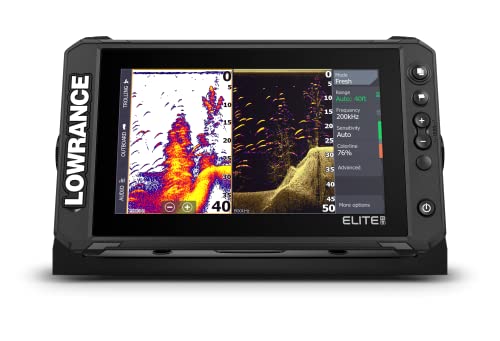
The Lowrance Elite FS 9 delivers crystal‑clear underwater insight with its Active Imaging 3‑in‑1 sonar, combining CHIRP, SideScan and DownScan plus FishReveal for unparalleled structure detail.
Real‑time fish behavior is captured by the Activetarget 2/2 XL Live Sonar, letting you watch bites and lure reactions as they happen.
A 9‑inch, high‑resolution multi‑touch display makes navigation and settings intuitive, while preloaded C‑MAP Contour+ charts give 1‑foot contour detail on 8,900 U.S. lakes.
Full networking options—including wireless, NMEA 2000, and Ethernet—let you integrate Halo Dome radar, Outboard Pilot, or share waypoints and sonar data across multiple displays, creating a seamless elite fishing system.
Key Specs
| Specification | Detail |
|---|---|
| Display | 9‑inch multi‑touch, high‑resolution |
| Sonar technology | Active Imaging 3‑in‑1 (CHIRP, SideScan, DownScan) + Activetarget 2/2 XL Live Sonar |
| Transducer | 3‑in‑1 Active Imaging HD (requires S3100) |
| Preloaded charts | C‑MAP Contour+ (1‑ft contours, 8,900 lakes) |
| Connectivity | Wi‑Fi, NMEA 2000, Ethernet, Bluetooth |
| Power input | 12 V/24 V (up to 250 W) |
| Operating temperature | -10 °C to 50 °C |
Best For
Serious anglers who need detailed structure imaging and live fish tracking on the water.
Pros
- Active Imaging 3‑in‑1 provides unmatched depth and bottom detail.
- Live Sonar shows fish movement in real time for smarter lure selection.
- Robust networking lets you expand the system with radar, pilot, and data sharing.
Cons
- Requires the optional S3100 module for full Active Imaging HD capability.
- Higher price point may be steep for casual weekend fishermen.
3. Humminbird Helix 5 GPS Fish Finder

The Humminbird Helix 5 G3 blends powerful Dual‑Spectrum CHIRP sonar with an intuitive GPS chartplotter, giving anglers crystal‑clear fish arches and detailed structure imaging.
Wide Mode blankets the water for quick scouting, while Narrow Mode hones in on precise targets thanks to a low‑Q transducer.
The built‑in Basemap covers more than 10,000 lakes and U.S. coastlines and syncs with LakeMaster, CoastMaster, and Navionics charts for seamless navigation.
AutoChart Live records depth contours, bottom hardness, and vegetation on‑the‑fly, storing up to eight hours of data and expanding via AutoChart Zero Line SD cards. Soft‑key navigation and a weather‑proof keypad keep controls reliable, even in rough conditions, making every outing both productive and stress‑free.
| Specification | Detail |
|---|---|
| Display | 5‑inch color LCD, 800×480 pixels |
| Sonar Frequencies | Dual‑Spectrum CHIRP: 83 kHz / 200 kHz |
| Transducer | Low‑Q, 200 kHz, 9‑ft (2.7 m) range |
| GPS | Built‑in Humminbird Basemap, WAAS‑enabled |
| Mapping Capacity | AutoChart Live, 8 hrs built‑in, SD‑card expand |
| Power Supply | 12 V DC, 1 A (max) |
| Operating Temperature | -4 °F to 122 °F (‑20 °C to 50 °C) |
| Weight | 2.3 lb (1.04 kg) |
Best For: Anglers who need precise fish locating and real‑time mapping on both lakes and coastal waters.
Pros
- Dual‑Spectrum CHIRP delivers both wide coverage and detailed target separation.
- AutoChart Live creates on‑the‑fly depth and vegetation maps with ample recording time.
- Soft‑key, weather‑proof keypad ensures reliable operation in any condition.
Cons
- No built‑in Wi‑Fi; requires external device for mobile app integration.
- Transducer depth limited to 9 ft, which may be insufficient for very deep water.
2. Humminbird PiranhaMAX 4 Fish Finder

The Humminbird PiranhaMAX 4 fish finder delivers crystal‑clear underwater imaging without the complexity of high‑end models. Its dual‑beam sonar lets you toggle between a narrow, high‑resolution beam for pinpointing fish and a wide, sweeping beam that maps larger structures and bottom contours.
The included tilt‑and‑swivel mount lets you fine‑tune the viewing angle on the fly, so you can adapt to changing water conditions or boat positions in seconds.
Paired with the XNT‑9 28 T transom‑mount transducer, the system provides reliable performance from shallow bays to deeper lakes, while the 1‑year limited warranty gives peace of mind for new anglers and seasoned captains alike.
| Key Spec | Detail |
|---|---|
| Sonar Type | Dual Beam (Narrow & Wide) |
| Display | 4‑inch color LCD |
| Transducer Model | XNT‑9 28 T (transom‑mount) |
| Mount Type | Tilt & Swivel |
| Warranty | 1‑Year Limited |
| Power Supply | 12 V DC (boat) |
| Frequency | 200 kHz (wide) / 800 kHz (narrow) |
Best For: Anglers who need versatile sonar coverage and quick angle adjustments on small to medium boats.
Pros
- Dual‑beam sonar offers both detail and wide‑area coverage.
- Tilt‑and‑swivel mount enables rapid angle changes without re‑installing.
- Compact, easy‑to‑install package includes transducer and mount.
Cons
- Limited to 4‑inch display; larger screens require an upgrade.
- Warranty is only one year, shorter than some competing models.
1. Humminbird XPLORE 9 Fish Finder

The Humminbird XPLORE 9 GPS Fish Finder blends cutting‑edge sonar with intuitive navigation, delivering crystal‑clear images of fish, structure, and the water column.
MEGA Side Imaging+ scans 200 ft to each side while MEGA Down Imaging+ reaches 200 ft depth, and Dual‑Spectrum CHIRP lets you toggle wide‑ or narrow‑band modes for pinpoint fish detection.
A 9‑inch Full HD touchscreen (1280 × 720) and keypad give dual control options, while built‑in GPS with Humminbird Basemap, LakeMaster, and CoastMaster VX map cards cover over 10,000 lakes across the U.S. and Canada.
Real‑time AutoChart Live creates depth‑contour, bottom‑hardness, and vegetation maps on‑the‑fly, storing up to eight hours of data. High‑speed Ethernet, Bluetooth, and NMEA 2000 compatibility ensure seamless integration with Minn Kota and Cannon accessories for a truly connected angling experience.
| Spec | Detail |
|---|---|
| Sonar | MEGA Side Imaging+ (200 ft), MEGA Down Imaging+ (200 ft), Dual‑Spectrum CHIRP |
| Display | 9‑in Full HD (1280 × 720) touchscreen + keypad |
| GPS/Maps | Built‑in GPS, Humminbird Basemap, LakeMaster & CoastMaster VX, Navionics compatible |
| Mapping | AutoChart Live, 8 hr recording, AutoChart Zero Line SD |
| Connectivity | Ethernet, Bluetooth, NMEA 2000 |
| Compatibility | Minn Kota, Cannon, Navionics charts |
Best For
Serious anglers who need high‑resolution imaging and real‑time mapping on any lake or coastal water.
Pros
- Ultra‑wide imaging (200 ft each side) and deep‑water down imaging.
- Full HD touchscreen with dual control options for easy operation.
- AutoChart Live creates detailed maps on‑the‑fly, storing up to eight hours of data.
Cons
- Premium price may be high for casual users.
- Requires SD card for full AutoChart functionality; extra accessory needed.
Buying Guide
Choosing the right transducer is crucial because it determines the clarity, depth range, and reliability of the sonar data your fish finder provides. Key considerations include build quality, performance specs, durability, cost efficiency, and the experiences of other anglers.
Key Factors Buyers Should Consider
Quality and Build
The transducer’s core material, such as solid‑state piezoelectric crystals, directly impacts signal clarity and depth penetration. Look for marine‑grade aluminum or stainless‑steel housings that resist corrosion. A well‑engineered mounting system reduces vibration, ensuring consistent readings across varying water conditions and speeds, during both calm and choppy water.
Performance Features
Pay attention to frequency range, beam angle, and power output. Dual‑frequency (e.g., 50/200 kHz) units provide both shallow‑water detail and deep‑water coverage. A narrow beam (≤20°) offers precise target resolution, while a wider cone (≥40°) covers larger areas, useful for scanning broad structures and helps locate fish schools efficiently.
Durability and Weather Resistance
Marine environments demand transducers that can withstand UV exposure, salt spray, and temperature fluctuations. Look for IP68‑rated seals and corrosion‑inhibiting coatings. Shock‑absorbing mounts protect against impacts from debris or accidental grounding, extending the unit’s lifespan and maintaining performance over years of use, even in harsh offshore conditions.
Value for Money
Balance price against features and longevity. Mid‑range models often deliver comparable sonar resolution to premium units while offering robust construction. Consider bundles that include mounting hardware and warranty extensions. A higher upfront cost can be justified if the transducer reduces the need for frequent replacements or upgrades.
User Reviews and Brand Reputation
Scrutinize real‑world feedback on installation ease, signal consistency, and after‑sales support. Established brands often have extensive service networks and firmware updates that improve performance over time. Positive community endorsements can signal reliability, while recurring complaints may highlight design flaws or inadequate customer service to consider before finalizing your purchase.
By evaluating these factors, you can select a transducer that delivers precise readings and stands up to tough water conditions, ensuring a better fishing experience. Invest wisely, and your fish finder will become a dependable partner on every outing.
Frequently Asked Questions
What frequency should I choose for my fish finder?
Choosing the right frequency depends on depth and target size. Low frequencies (50‑200 kHz) penetrate deeper water but show less detail, ideal for offshore or deep‑lake fishing. High frequencies (200‑800 kHz) provide finer resolution for shallow water and smaller fish, but their range is limited. A dual‑frequency unit offers the best of both worlds.
How does cone size affect transducer performance?
A larger cone (e.g., 7 inches) creates a narrower, longer‑range beam, useful for deep water and pinpointing fish schools. Smaller cones (5‑6 inches) produce a wider fan, covering more area in shallow or structure‑rich environments. Match cone size to your typical fishing depth and improve target separation when navigating complex bottom contours.
Are dual‑beam transducers better than single‑beam ones?
Dual‑beam transducers send two overlapping pulses, giving a broader coverage area and better depth perception than single‑beam units. They excel in environments with varying bottom topography, as one beam can compensate for blind spots of the other. However, they consume more power and may be pricier, so weigh the benefits against your budget.
Which brands/models are top‑tier for freshwater vs. saltwater?
For freshwater, the Humminbird 770‑12 with a 12‑inch dual‑frequency transducer is praised for its clear imaging and solid build. In saltwater, the Garmin Panoptix 4 in. CHIRP transducer stands out, delivering high‑resolution CHIRP, side‑scan, and down‑scan in one package. They also offer customizable gain controls to fine‑tune performance in varying water conditions.
Conclusion
Choosing the right transducer hinges on matching its capabilities to your fishing environment, vessel size, and budget, while ensuring reliable performance under varied conditions.
Prioritize models that deliver clear, high‑resolution sonar imaging, robust construction, and flexible mounting options to maximize coverage and durability.
Consider the importance of power output, frequency range, and beam angle in relation to depth and target detection needs, and don’t overlook integration ease with your existing fish‑finder system.
By weighing these factors, you’ll equip yourself with a transducer that not only enhances your underwater visibility but also boosts confidence and success on every outing.