
Fishing › Guides › Ice Fishing for Panfish
To ice fish for panfish, drill holes over weed edges or deep basins, drop a tiny jig tipped with a waxworm or maggot on 2 to 4 lb line, and fish it close to the bottom or just above suspended fish. Work the jig with small, quiet jiggles and long pauses, and watch your rod tip or spring bobber closely, because panfish bites in cold water are very light. Before you go, make sure the ice is safe: at least 4 inches of clear, solid ice is the common minimum for walking.
Key takeaways
- Use light gear: an ultralight rod, 2 to 4 lb line and tiny jigs, because cold-water panfish are cautious and bite softly.
- Find fish first. Early and late ice put panfish shallow near weeds; midwinter often pushes them to deeper basins and edges.
- Jig less than you think. Small shakes followed by long pauses catch more fish than big, fast lifts.
- Watch the rod tip or a spring bobber for any tick, lift or slack line, and set the hook with a gentle wrist lift.
- Check ice thickness with a spud bar or auger as you go, carry ice picks, and never fish alone on unfamiliar ice.
In this guide
- The Gear You Need to Ice Fish for Panfish
- Where to Find Panfish Under the Ice
- How to Jig for Panfish, Step by Step
- Reading the Bite and Setting the Hook
- Baits, Colors and When to Use a Bobber
- Common Beginner Mistakes
- Ice Safety Before You Fish
The Gear You Need to Ice Fish for Panfish
Panfish setups are simple and cheap compared to most ice fishing. You need a way to make holes, a short, sensitive rod, light line, a few small jigs, and some live bait. Everything else, like electronics and shelters, makes you more comfortable or efficient, but you can catch fish without it.
The rod matters more than beginners expect. A short ultralight or panfish-specific ice rod lets you feel tiny bites and keep your jig still. Look for something with a soft, sensitive tip, and pair it with a small spinning reel or an inline reel, which helps keep light line from twisting. Our guide to ice fishing poles for panfish covers good options.
Line should be light and thin. Most anglers use 2 to 4 lb test monofilament or fluorocarbon, since cold water is usually clear and panfish can be line shy. Some prefer a light braid main line with a fluorocarbon leader for better feel in deeper water.
Basic panfish ice setups
| Item | Typical choice | Why it matters |
|---|---|---|
| Rod | 24 to 32 in. ultralight, soft tip | Shows light bites and keeps jig movement small |
| Reel | Small spinning or inline reel | Handles light line with less twist |
| Line | 2 to 4 lb mono or fluorocarbon | Thin line gets more bites in clear water |
| Jigs | 1/64 to 1/32 oz, tungsten or lead | Small profile matches tiny winter food |
| Bait | Waxworms, spikes, small plastics | Adds scent and movement |
| Auger | 6 in. hand or power auger | Plenty big for panfish, easy to carry |
Making holes
A 6-inch hand auger is plenty for panfish and is light and easy to carry. A 6 or 8-inch hole fits nearly any bluegill, crappie or perch. Power augers help if you plan to drill a lot of holes, which is often the key to finding fish.
Nice-to-have extras
A skimmer or ladle to clear slush, a bucket to sit on, and a flasher or sonar unit make a big difference. Electronics show you the depth, your jig and fish as they rise to look at it, which cuts down on guessing.
Where to Find Panfish Under the Ice
Panfish move through the winter, and where they hold depends on oxygen, food and cover. Finding them is usually the hardest part. A good plan is to start in likely areas, drill several holes, and spend only a few minutes in each before moving.
Bluegill and sunfish love green, living weeds, because weeds hold insects and give off oxygen. Crappie often suspend over deeper water, especially basins and soft-bottom flats, and roam in schools. Yellow perch tend to stay near the bottom over sand, gravel or muck flats and along drop-offs.
Where panfish tend to be through the season
| Period | Bluegill and sunfish | Crappie | Perch |
|---|---|---|---|
| Early ice | Shallow green weeds | Weed edges, nearby basins | Shallow flats near weeds |
| Midwinter | Deeper weed edges and humps | Suspended over deep basins | Bottom of deeper flats and drop-offs |
| Late ice | Back toward shallow bays | Edges near shallows, inlets | Shallow flats again |
Early ice
Right after safe ice forms, panfish are often in the same shallow weedy bays they used in late fall, commonly in roughly 5 to 15 feet of water. This is a great time for beginners, as fish are usually active and easy to reach.
Midwinter
As weeds die back and oxygen drops in the shallows, many panfish slide to deeper weed edges, humps and basins. Crappie may suspend in the middle of the water column, so watch your electronics or try several depths.
Late ice
As snow melts and sunlight gets through the ice, fish often push back toward the shallows and inlets. Bites can get strong, but this is also when ice is weakest, especially near shore and moving water.
How to Jig for Panfish, Step by Step
Jigging for panfish is about control. Cold water slows fish down, so they want a small bait that moves a little and then sits still. Big, fast jerks that work for walleye often spook panfish.
The basic routine is simple: drop your jig to the right depth, give it small shakes, then pause and watch for a bite. Most bites come during or right after the pause, when the bait settles and hangs in place.
If you have a flasher or sonar, watch how fish react. A fish that rises and then sinks away was interested but not sold, so make your movement smaller or try a different bait. A fish that charges in fast wants more action.
Jigging for panfish, the basic routine
- Find the depthDrop the jig to the bottom, then reel up a turn or two so it hangs just above it, or set it at the depth where you see fish.
- Tip the jigAdd one or two waxworms or spikes, or a small plastic, hooked so it hangs naturally and does not cover the hook point.
- Jiggle softlyShake the rod tip in tiny movements for a few seconds so the bait quivers instead of jumping.
- Pause and watchStop completely and hold the rod still for 5 to 15 seconds while you watch the tip or spring bobber.
- Raise slowlyLift the jig a few inches at a time to find fish that are suspended higher.
- Change one thingIf you get no bites after a few minutes, change depth, jig color or bait before you move holes.
Simple jigging cadences to try
The quiver: shake the rod tip in tiny, fast movements so the jig shimmers in place, then stop. The lift and hold: raise the jig a few inches slowly, hold it, then let it fall back. The dead stick: let the bait sit motionless for 10 to 20 seconds, which can trigger fussy fish when nothing else works.
Reading the Bite and Setting the Hook
Panfish rarely slam a bait in winter. A bluegill often just sucks it in and stops, so the bite may show as a tiny tick, a slight dip, or the rod tip rising when the fish lifts the jig and takes the weight off your line. Any change from normal is worth a hookset.
Spring bobbers are thin wire or plastic tips that attach to the end of your rod and make light bites easier to see. Many panfish anglers swear by them. Adjust it so your jig weight bends it slightly, and watch for any bounce, drop or lift.
Set the hook with a quick, short lift of the wrist, not a big sweep. Panfish have small, soft mouths, and a hard hookset on light line can tear the hook free or snap the line. Once the fish is on, reel steadily and keep the rod tip up.
When the fish reaches the hole, guide its head into the hole first and lift it out in one smooth motion. Do not pause with the fish halfway out, since that is where many come off.
Tip: If you keep missing fish, your bait may be too big or hanging past the hook. Trim waxworms or plastics so the fish gets the hook in its mouth, and try a slightly smaller jig.
Baits, Colors and When to Use a Bobber
Live bait is the standard for panfish through the ice. Waxworms and spikes (maggots) are the most common, and many bait shops in ice fishing regions sell them all winter. Hook a waxworm once through the end, or thread on two or three spikes so they wiggle.
Small soft plastics are a good option when fish are active or you are tired of rebaiting. Tiny tails and nymph shapes add movement with little effort. Some anglers tip a jig with both a plastic and a single spike for scent.
Color choices are more about confidence than rules, but common starting points are glow colors in low light, natural or dark colors in clear water, and bright colors like chartreuse or pink in stained water. Charge glow jigs with a light before you drop them. For ideas on what to stock, see our roundup of ice fishing lures for panfish.
Common panfish baits under the ice
| Bait | How to rig | Best use |
|---|---|---|
| Waxworm | Hook once near the end | All-around choice for bluegill and perch |
| Spikes (maggots) | Thread 2 or 3 on the hook | Fussy fish, small jigs |
| Small soft plastics | Thread on straight | Active fish, less rebaiting |
| Minnow (small) | Hook lightly behind the dorsal fin | Crappie, under a bobber |
Using a bobber instead of jigging
A small float set at the right depth is a great second line, if your state allows more than one line. Rig a plain hook or small jig with a waxworm under a float, set it just above the fish, and let it sit. It also works well for kids and beginners. Use a float small enough that a light bite pulls it under, and keep the hole clear of ice.
Common Beginner Mistakes
Most slow days on the ice come down to a handful of mistakes. The good news is that each one is easy to fix once you know about it.
Staying in one hole too long is the biggest. If you have not seen a fish or had a bite in 10 to 15 minutes, move. Drilling several holes in a line from shallow to deep lets you check different depths quickly.
Jigging too hard is next. Big lifts and drops send the jig far from the fish and look unnatural in cold water. Keep movements small and pause often.
Using line that is too heavy cuts down on bites and makes tiny jigs act stiff. Stick with 2 to 4 lb test for most panfish. Our guide to ice fishing line for panfish explains the options.
Fishing at the wrong depth is another. Panfish usually look up to feed, so a bait sitting below them gets ignored. Start just off the bottom and work up.
Finally, many people quit too early in the day. Crappie in particular often bite best around dawn and dusk, so plan to be on the ice during low light if you can.
Ice Safety Before You Fish
No fish is worth falling through the ice. Ice is never perfectly safe, and thickness can change a lot over short distances, especially near inlets, outlets, springs, docks, pressure ridges and moving water.
A common guideline used by many state agencies is at least 4 inches of clear, solid ice to walk on, with more needed for snowmobiles, ATVs and vehicles. White or cloudy ice, snow-covered ice and ice that has thawed and refrozen are weaker than clear ice. Check your state’s natural resources agency for local guidance.
Test the ice as you go with a spud bar or by drilling test holes, and measure thickness with a tape or ice gauge. Ask at local bait shops about current conditions, and avoid ice that looks gray, dark or slushy.
Dress in layers, keep your hands and feet dry, and bring a spare pair of gloves. Wind on open ice can make cold much worse than the thermometer says. Rules on number of lines, shanty placement and bag limits also differ by state and lake, so read the current regulations before you go.
Ice safety checklist
- Ice picks worn around your neck or on your jacket
- Spud bar or auger to test ice as you walk
- Tape or gauge to measure ice thickness
- A throw rope
- Fishing buddy, or someone who knows exactly where you are
- Fully charged phone in a waterproof bag
- Warm layers, waterproof boots and spare gloves
- Current fishing license and local regulations
Gear that helps
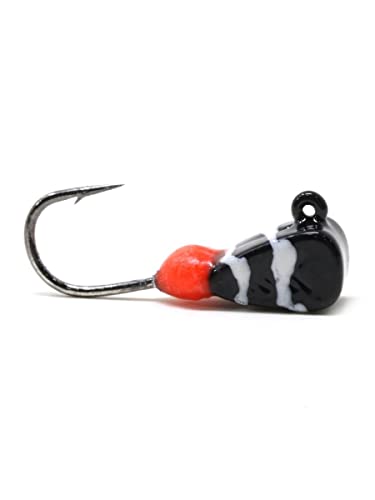
Our guide
6 Best Ice Fishing Lures for Panfish
Tiny jigs and spoons are the main tool for jigging panfish, and the right size and color makes a big difference.

Our guide
9 Best Ice Fishing Lines for Panfish
Light, thin line in the 2 to 4 lb range gets more bites and lets small jigs move naturally.

Our guide
7 Best Fish Finders for Ice Fishing
A flasher or sonar shows depth, your jig and fish, so you can find panfish faster and see how they react.
Questions
What is the best bait for ice fishing panfish?
Waxworms and spikes (maggots) are the most popular baits for bluegill, crappie and perch through the ice. Small soft plastics also work well, especially when fish are active. Small minnows are a strong choice for crappie under a bobber.
How deep should I fish for panfish under the ice?
It depends on the season and lake. Early and late ice often find panfish in roughly 5 to 15 feet near weeds, while midwinter can push them to deeper edges and basins. Start just off the bottom and work your jig up, since panfish often feed looking up.
How do you jig for panfish when ice fishing?
Drop a small jig tipped with bait to just above the bottom or to the depth where you see fish. Shake the rod tip in tiny movements for a few seconds, then pause and hold still while you watch for a bite. Most bites come on the pause, so keep movements small and stops long.
What size line should I use for ice fishing panfish?
Most anglers use 2 to 4 lb test monofilament or fluorocarbon for panfish. Lighter line is harder to see in clear winter water and lets tiny jigs move naturally. Go toward the heavier end if you fish around thick weeds or expect bigger perch and crappie.
What time of day is best for ice fishing panfish?
Bluegill and perch often bite through the middle of the day, especially in shallow weeds. Crappie tend to be most active around dawn and dusk and into early darkness. If you can, fish the low-light periods for the best chance at crappie.
Update log
Rewritten and expanded: clearer answers, 7 visual summaries, FAQ and related gear guides.


